

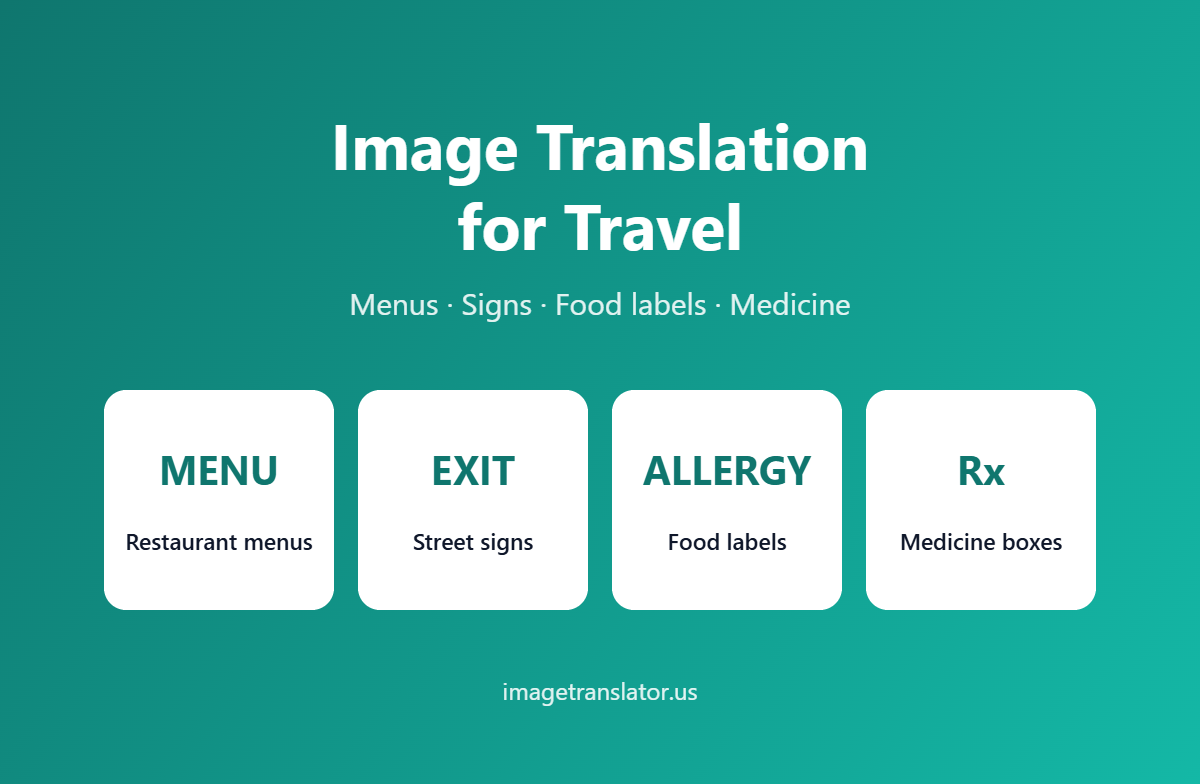
When you travel somewhere you cannot read the local script, small everyday tasks suddenly become puzzles: ordering food, finding the right platform, checking what is inside a snack, or making sure a medicine is safe to take. A phone camera and an image translator solve most of these problems in seconds. This guide brings together everything we have written about translating text in photos while traveling, so you can jump straight to the situation you are dealing with.
How image translation works when you travel
The process is the same whatever you photograph. You take a clear picture of the text, upload it, choose the source language (or let the tool detect it) and the language you want, and the translator reads the characters with OCR before translating them. The result depends more on the photo than on anything else: steady hands, even light and a straight-on angle make a big difference. Our guide to taking photos that translate accurately explains exactly what to do.
The situations travelers face most often
Restaurant menus
Menus are the most common reason travelers reach for a translator. Short dish names translate well, but regional dishes, handwritten specials and decorative fonts can confuse any tool. Our step-by-step guide on translating a foreign restaurant menu with your phone camera covers glare on laminated menus, long menus split across pages, and how to double-check ingredients.
Street signs, stations and airport boards
Signs are usually printed in clean, high-contrast fonts, which makes them ideal for OCR. Departure boards change quickly, so photograph first and translate afterwards instead of trying to read them live. See how to translate street signs and airport boards while traveling.
Food labels and ingredient lists
If you have allergies, follow a vegetarian diet or keep religious food rules, the ingredient list matters far more than the name on the front of the pack. Tiny print and curved packaging are the main obstacles. Read how to translate product labels and ingredient lists while traveling to capture every line.
Medication labels
Pharmacies abroad often use different brand names, units and dosage formats. A translation helps you understand the box, but it should never replace a pharmacist or doctor. Our guide to translating medication labels safely when abroad explains what to check and when to ask a professional.
Languages travelers ask about most
Scripts that look nothing like English are where image translation helps the most, and also where accuracy varies the most. Each one has its own pitfalls, from right-to-left Arabic to vertical Japanese text. Start with our guide to translating a photo from any language to English, or go straight to a specific language:
- Arabic text in images to English
- Chinese text in images to English
- Japanese text in images to English
- Russian text in photos to English
- Hindi and Urdu text in images
Practical tips before you fly
- Test at home. Try the translator on a few photos in your destination’s language before the trip, so you know how it handles that script.
- Plan for connectivity. Online translators need data. Check your roaming plan or buy a local SIM or eSIM on arrival.
- Carry a power bank. The camera, screen and mobile data drain your battery quickly on busy travel days.
- Keep screenshots. Save translations of addresses, hotel instructions and dietary notes so you can show them offline.
- Confirm anything important. For safety, legal or medical decisions, check the meaning with a local person, pharmacist or official source.
Limits you should know about
Machine translation is very good at giving you the gist and much weaker at nuance. Handwriting, stylised fonts, low light, reflections and mixed languages on the same sign all reduce accuracy. Treat the result as a helpful guide rather than a certified translation, and if something looks odd, retake the photo closer and straighter before translating again. Our comparison of AI image translators, OCR and manual translation explains where each approach works best.
Further Reading
- International nonproprietary names: why the same medicine has different brand names in different countries.
- Food allergy: common allergens to look for on foreign labels.
All travel translation guides
- How to Translate a Foreign Restaurant Menu with Your Phone Camera
- How to Translate Street Signs and Airport Boards While Traveling
- How to Translate Product Labels and Ingredient Lists While Traveling
- How to Translate Medication Labels Safely When Abroad
- Tips for Taking Photos That Translate Accurately
Ready to try it? Upload a photo to our free image translator and see the translation in seconds.
