
This article is part of our complete guide to image translation for travel. To translate your own picture right now, use our free image translator.
Traveling to another country can be exciting, but dealing with medication labels in an unfamiliar language can quickly become stressful. Prescription bottles, over-the-counter medicines, dosage instructions, warnings, and ingredient lists may contain important information that you need to understand before taking a medicine.
Fortunately, modern image translation and OCR tools can help travelers understand text on medication packaging more quickly. By taking a clear photo of a medicine label and translating the visible text, you can get a better idea of what the packaging says in your preferred language.
However, medication translation requires extra care. A machine translation should help you understand a label, but it should not replace advice from a doctor, pharmacist, or other qualified healthcare professional.
In this guide, we’ll explain how to translate medication labels safely when abroad, what information to look for, and how an image translation tool such as ImageTranslator.us can help.
Why Medication Label Translation Matters While Traveling
Medication labels often contain much more than the name of a medicine. Depending on the country and product, a package may include:
- Active ingredients
- Strength or concentration
- Dosage instructions
- Warnings and precautions
- Storage instructions
- Expiration dates
- Possible side effects
- Manufacturer information
- Age restrictions
- Directions for use
- Allergy information
- Prescription information
When these details are written in an unfamiliar language, it can be difficult to determine exactly what a product is intended for.
For example, a traveler might recognize a brand name but not know whether the product contains acetaminophen, ibuprofen, an antihistamine, or another active ingredient. Translating the label can make the information easier to understand and discuss with a pharmacist or doctor.
Can You Translate a Medication Label from a Photo?
Yes. Image translation technology can recognize text contained in a photograph and convert it into another language.
Instead of typing every word manually, you can photograph the medication packaging and use an image translation tool to process the visible text.
This can be particularly useful when you’re traveling in countries where you cannot easily read the local writing system.
For example, you might encounter medication packaging written in:
- Japanese
- Chinese
- Korean
- Arabic
- Thai
- French
- German
- Spanish
- Italian
- Portuguese
An image translator can help turn unfamiliar text into a language you understand, making it easier to identify important information on the package.
How to Translate a Medication Label with ImageTranslator.us
If you have a medication package with text you cannot read, you can use ImageTranslator.us to translate the visible information.
Step 1: Take a Clear Photograph
Start by taking a clear photo of the medication label.
Make sure the camera captures the complete text and that the packaging is not blurry. Avoid taking the photograph at an extreme angle.
For bottles, boxes, or small packages, you may need to take several photographs from different angles.
Step 2: Upload the Image
Open ImageTranslator.us and upload the medication label image.
A clear image generally makes it easier for OCR and translation systems to recognize the text accurately.
If the label contains several sections, consider translating each important section separately rather than uploading a distant photograph containing tiny text.
Step 3: Select the Translation Language
Choose the language you want the medication information translated into.
For example, if you are traveling in Japan and cannot read Japanese, you can translate the visible Japanese text into English.
Step 4: Review the Translated Information
Once the translation is generated, carefully review the result.
Pay particular attention to:
- Medicine name
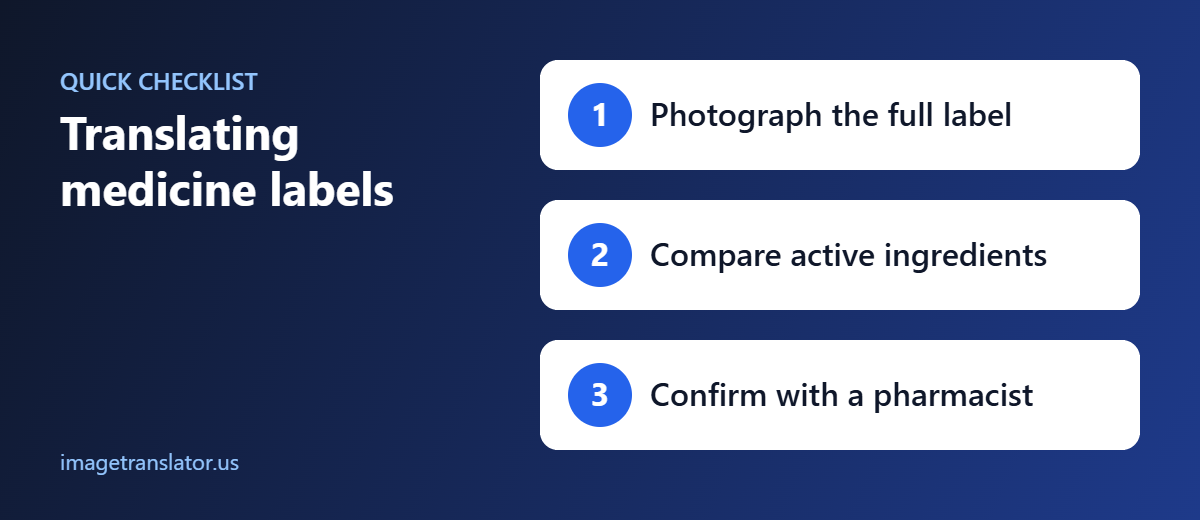
- Active ingredients
- Strength
- Dosage information
- Warnings
- Age restrictions
- Storage instructions
- Expiration date
- Frequency of use
If any important information appears unclear or unusual, do not guess what it means.
Step 5: Confirm with a Pharmacist or Doctor
For medication decisions, professional confirmation is important.
Show the original packaging and the translated information to a pharmacist or doctor when possible. They can help verify the medicine, ingredients, appropriate use, and potential interactions.
Always Check the Active Ingredient
One of the most important parts of a medication label is the active ingredient.
Brand names can vary significantly between countries. A medicine sold under one brand name in one country may have a different brand name elsewhere.
The active ingredient provides a more useful way to identify what the medicine actually contains.
When translating a label, look for terms such as:
Active ingredient: The substance responsible for the medicine’s intended effect.
Strength: The amount or concentration of the active ingredient.
Dosage: Instructions describing how much and how often the medicine should be taken.
Do not assume two products are equivalent simply because their packaging or intended purpose appears similar.
Be Careful with Dosage Instructions
Dosage information deserves special attention when translating medication labels.
Numbers can be misread by OCR systems, especially when the original photograph is blurry or the text is very small.
A translation might also fail to clearly communicate abbreviations or specialized medical terminology.
For example, a label may contain information about:
- Number of tablets
- Milligrams
- Milliliters
- Frequency
- Maximum daily amount
- Duration of treatment
- Age or weight requirements
Always compare the translated information with the original label and ask a healthcare professional if you are uncertain.
Watch Out for Similar-Looking Medicines
Some medications may have similar names or packaging while containing different active ingredients.
This is particularly important when purchasing medicine in another country.
Do not select a medicine solely because the translated name appears familiar. Instead, verify the active ingredient, strength, intended use, and other relevant information.
If you’re unsure, take the packaging to a local pharmacist and ask them to identify it.
Translate Both the Front and Back of the Package
The front of a medicine package often contains the product name and basic information, but important safety instructions may appear elsewhere.
When possible, photograph and translate:
- Front of the box
- Back of the box
- Side panels
- Bottle label
- Instruction leaflet
- Warning section
- Ingredient panel
This gives you a more complete understanding of the product.
For medicine sold with a separate information leaflet, translating only the front of the package may leave out important warnings.
How Image Translation Helps in Pharmacies Abroad
Image translation can also be useful when communicating with a pharmacist.
Suppose you have a medication package written in a language you cannot read. You can translate the label first to understand the basic information, then show the original package to the pharmacist.
This can make communication easier because you have already identified important words and ingredients.
You can also use image translation to understand signs, instructions, or product information inside a foreign pharmacy.
However, a translation tool should be considered a communication aid rather than a substitute for professional medical advice.
What If the Translation Looks Wrong?
Never ignore an obviously incorrect or confusing translation when medication is involved.
Several factors can affect image translation accuracy, including:
- Blurry photographs
- Poor lighting
- Reflections on glossy packaging
- Tiny text
- Curved bottles
- Damaged labels
- Unusual fonts
- Handwritten information
- Medical abbreviations
- Complex terminology
If the result doesn’t make sense, take another photograph with better lighting and a closer view.
You can also translate individual sections separately.
Most importantly, consult a pharmacist or healthcare professional before taking a medicine if you are uncertain about its identity or instructions.
Keep the Original Medication Packaging
When traveling internationally, it is useful to keep medicines in their original packaging whenever possible.
Original packaging can help healthcare professionals identify the product and its ingredients.
It may also contain information that is not visible in a photograph, such as a batch number, manufacturer details, prescription information, or additional warnings.
Avoid relying exclusively on a translated screenshot or copied text. Keep the original label available for reference.
Medication Translation and Allergies
People with allergies need to be particularly careful when interpreting medication labels.
A translated label can help you identify ingredients, but an automated translation should not be treated as definitive confirmation that a medicine is safe for you.
If you have a known allergy, show the original packaging to a pharmacist or doctor and clearly communicate your allergy.
If necessary, ask the healthcare professional to verify the complete ingredient list.
What About Prescription Medicines?
Prescription medication requires additional caution.
If you are carrying your own prescription medicine abroad, keep the medication in its original packaging and carry relevant prescription or medical documentation when appropriate.
If you need to obtain or replace prescription medication while traveling, do not rely solely on an image translation.
A local healthcare professional may need to confirm the medication, dosage, prescription status, and appropriate alternative.
Image translation can help you understand the information printed on a package, but it does not establish that a particular medication is medically appropriate for you.
Tips for Taking Better Medication Label Photos
For the best possible image translation results, follow these simple tips:
Use Good Lighting
Take photographs in bright, even lighting. Avoid strong reflections and shadows.
Hold the Camera Steady
Blurred text can cause OCR errors. Keep your phone steady when taking the photograph.
Capture Text Straight-On
Try to photograph the label directly rather than from a sharp angle.
Move Closer
If the text is tiny, move closer instead of relying on digital zoom.
Photograph Important Sections Separately
If the package contains lots of text, take several close-up photographs.
Keep the Original Image
Save the original photograph so you can show it to a pharmacist or doctor if necessary.
When You Should Not Rely on Machine Translation
Image translation is useful for understanding written information, but certain situations require professional assistance.
Do not rely solely on automated translation when:
- You are unsure what medicine you have.
- The active ingredient cannot be identified.
- The dosage is unclear.
- You have a serious medication allergy.
- The medicine is intended for a child.
- You are pregnant or breastfeeding and have medication questions.
- You take multiple medicines and are concerned about interactions.
- The label contains unclear or conflicting instructions.
- You are experiencing a serious reaction or medical emergency.
In these situations, speak with a qualified healthcare professional.
A Simple Medication Translation Checklist
Before using an unfamiliar medication abroad, check:
- What is the medicine called?
- What are the active ingredients?
- What is the strength?
- What is the intended use?
- What are the dosage instructions?
- Are there important warnings?
- Are there allergy-related ingredients?
- What is the expiration date?
- Does the packaging match the translated information?
- Has a pharmacist or doctor confirmed anything that remains unclear?
This checklist can help you avoid relying on a single translated phrase when important medication information is involved.
Final Thoughts
Understanding medication labels while traveling can be difficult when you don’t speak the local language. Image translation provides a convenient way to turn unfamiliar text from medicine bottles, boxes, and instruction leaflets into a language you can understand.
With ImageTranslator.us, you can translate text from a medication label image and use the result as a helpful starting point for understanding the packaging.
However, medication safety requires more than translation. Always verify important information such as active ingredients, strength, dosage, warnings, and allergies. When there is any uncertainty, show the original medication packaging to a pharmacist or doctor.
Used responsibly, image translation can make international travel easier while helping you navigate unfamiliar medication labels more confidently.
Further Reading
- International nonproprietary names: why generic drug names are more reliable than brand names abroad.
- Over-the-counter drugs: how non-prescription medicines are regulated.
