

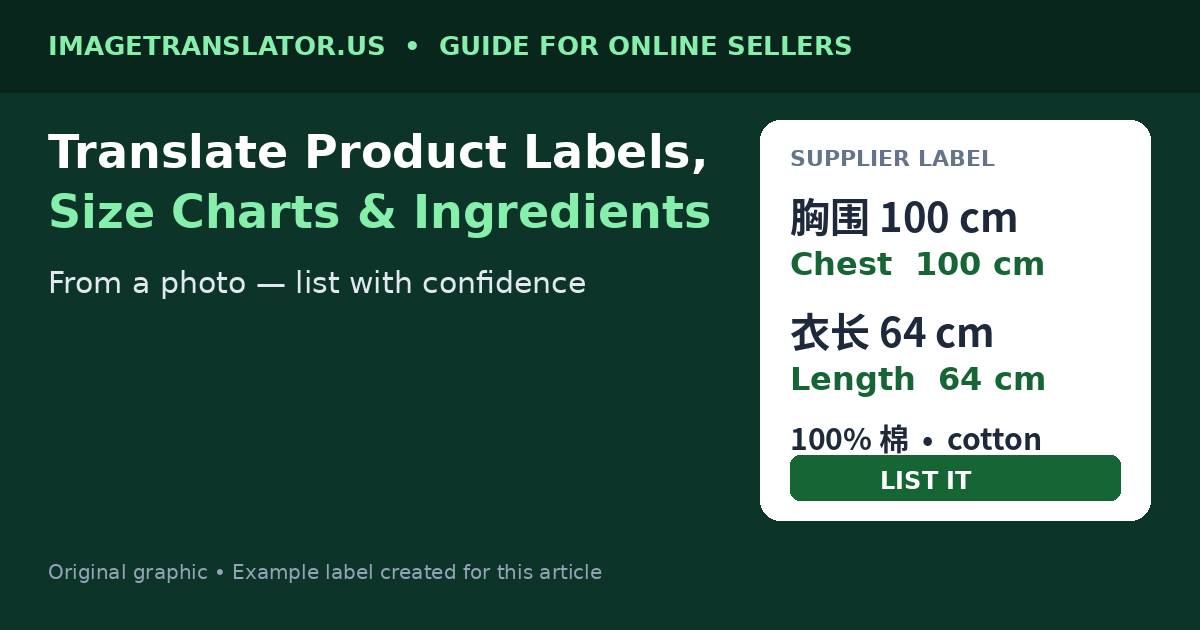
How to Translate Product Labels, Size Charts and Ingredient Lists From Photos for Online Selling
If you sell online — on Amazon, eBay, Etsy, Shopify or your own store — you have probably been here: a supplier sends a photo of a product, and everything you need to list it is written in a language you cannot read. The size chart is in Chinese, the ingredient list is in Korean, the care label is in Turkish, and the manual is a scanned PDF in German. Translating product images is a daily job for resellers and importers, and getting it wrong costs real money: wrong sizes mean returns, wrong ingredients mean complaints, and wrong safety information means trouble.
This guide shows you how to translate product labels, size charts and ingredient lists from photos accurately enough to list with confidence — and where to stop and get a human check. Start here: upload the supplier’s photo to our free image translator, pick the language on the label and English as the target, and you will have a readable translation in seconds.
What Sellers Actually Need Translated
Supplier photos contain several different kinds of text, and each one needs a different level of care:
- Size charts — the table of measurements that decides whether a customer keeps the item or sends it back. Numbers matter more than words here.
- Ingredient and allergen lists — what is in a food, cosmetic or supplement. A wrong ingredient can trigger an allergy or a marketplace policy violation.
- Care and washing labels — washing, drying and ironing instructions, often as a mix of words and symbols.
- Product specifications — materials, dimensions, voltage, capacity, model numbers and certifications.
- Manuals and instruction sheets — assembly steps, safety warnings and warranty terms that came only in the supplier’s language.
- Packaging and marketing claims — the words on the box, which you may want to reuse (carefully) in your own listing.
The first rule for all of them: translate to understand, then write your listing in your own words. Never paste a machine translation straight into a product listing. It will read oddly, it may overstate a claim, and if the translation is wrong, the mistake becomes your listing.
How to Translate a Product Label From a Photo
The basic process is quick, and it works for almost any label:
- Ask the supplier for the original photo, not a photo of a screen. A screenshot of a listing or a photo of a monitor adds glare and distortion. The original image file is always sharper — and if the supplier can send a PDF or a flat scan, that is better still.
- Crop to one panel at a time. Labels are dense. Photograph the ingredient panel on its own, then the size chart, then the warnings. One block of text per translation gives far cleaner results than a whole box in one shot.
- Upload it to the image translator. Set the source language to the language on the label — Chinese, Korean, Turkish or whichever it is — and English as the target. If the label is Chinese, our Chinese to English image translator has Chinese already selected.
- Read the detected text first, then the translation. If the tool misread a character, the English will be wrong too. Compare the detected text with the photo and re-crop if a word looks off.
- Check numbers against the original photo yourself. Never trust a translated number alone. Compare every measurement, weight, voltage and date digit-by-digit with the label in the photo.
Our guide to translating Chinese text in images to English covers the most common supplier language in detail, including the difference between Simplified and Traditional characters on packaging.
Size Charts: The Numbers Matter More Than the Words
Size charts cause more returns than any other listing mistake, and they are also the easiest translations to get wrong — because a size chart is mostly numbers, and numbers are exactly what machine translation handles worst.
Here is a realistic example we made ourselves — a size chart as it might appear on a supplier’s photo, in Chinese, with the English translation:
| 尺码 (Size) | 胸围 (Chest) | 衣长 (Length) | 肩宽 (Shoulder) |
|---|---|---|---|
| S | 96 cm | 62 cm | 40 cm |
| M | 100 cm | 64 cm | 42 cm |
| L | 104 cm | 66 cm | 44 cm |
| XL | 108 cm | 68 cm | 46 cm |
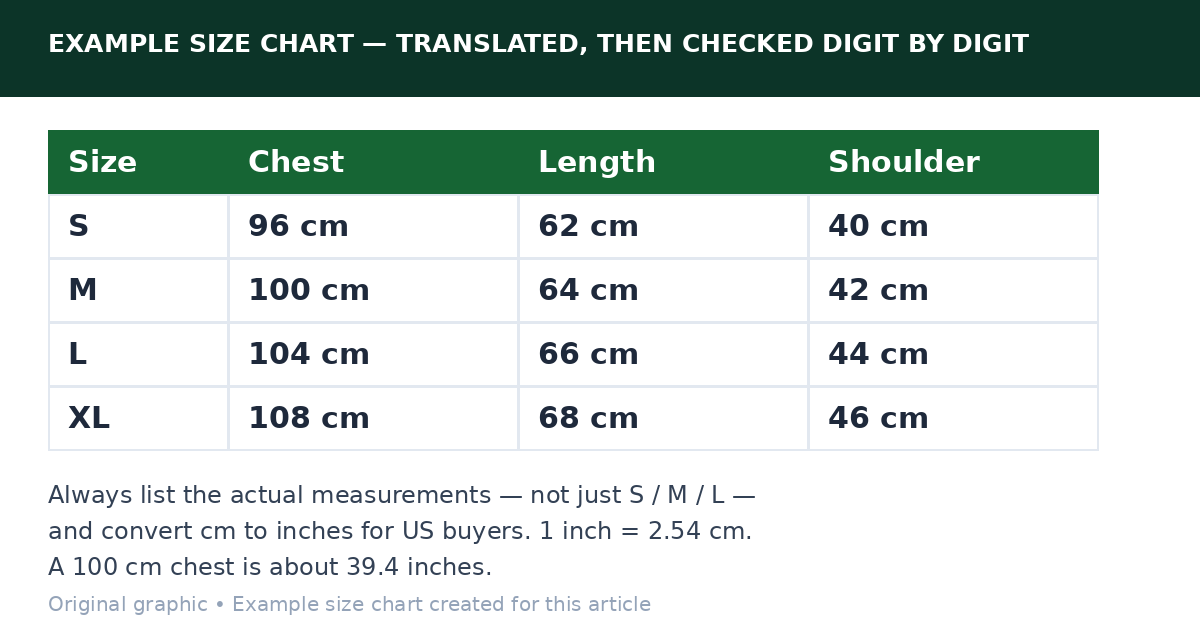
The words translate easily — 胸围 is chest, 衣长 is length, 肩宽 is shoulder width. The danger is in the numbers and the units:
- Check the unit. Chinese size charts are almost always in centimetres; US buyers expect inches. Convert every figure (1 inch = 2.54 cm) and show both units in your listing. A 100 cm chest is about 39.4 inches — never guess the conversion.
- Check whether it is the garment or the body. Some charts give the measurements of the garment laid flat; others give the body measurements the size is meant to fit. A flat chest measurement is roughly double the number shown if the chart measured half the garment. If the listing does not say which, ask the supplier — a translated chart cannot tell you.
- Watch for Asian vs Western sizing. An “L” from a Chinese supplier is often closer to a Western “M”. Always list the actual measurements in your listing, not just the letter size, so buyers can compare with a garment they already own.
- Verify every digit. A misread “96” that becomes “98” is a return waiting to happen. Read each number in the translated result against the number in the photo before you publish.
If the size chart is a photo of a printed table, translate it one column at a time: first the headers, then each row. Tables confuse OCR when the columns are narrow, so narrow crops give cleaner results.
Ingredient Lists and Allergen Warnings
Ingredient lists are the highest-stakes text a seller translates. A wrong ingredient on a food, cosmetic or supplement listing can cause an allergic reaction, a marketplace takedown or a legal problem. Treat these translations with the most care:
- Translate the full list, not single words. Ingredient names make sense in context — translating one word at a time loses the order and the quantities. Upload the whole ingredient panel as one image.
- Look for the allergen words first. Learn the words for the major allergens in your supplier’s language, or keep a reference list: peanut, tree nut, milk, egg, wheat/gluten, soy, fish, shellfish and sesame. In Chinese, for example, 花生 is peanut, 牛奶 is milk and 小麦 is wheat. If any of them appear, flag them prominently in your listing.
- Do not trust a translation of a dosage or concentration. Percentages, milligrams and “contains X%” figures must be checked digit by digit against the original. If a number is unclear in the photo, ask the supplier for the figure in writing.
- Keep the original ingredient list on file. Save the supplier’s photo and your translation together. If a customer ever questions an ingredient, you can show exactly what the supplier provided.
- Get a human check before you publish. For anything people eat, put on their skin or take as a supplement, a machine translation is a first draft, not a final listing. A bilingual speaker or a professional translator should confirm the ingredient list before it goes live.
Care Labels and Washing Symbols
Care labels are a special case, because half the information is not words at all — it is symbols. A triangle, a circle, a square with a circle inside: these are international laundry symbols, and no translator will read them, because there is nothing to translate.
What you can do is translate the words around the symbols, then decode the symbols separately. The common ones are worth memorising:
- A wash tub with a number is the maximum water temperature; a hand in the tub means hand wash only; a cross through it means do not wash.
- A triangle means bleaching is allowed; a crossed triangle means do not bleach.
- A square with a circle is tumble drying; dots inside show the heat level, and a cross means do not tumble dry.
- An iron with dots shows the ironing temperature; a crossed iron means do not iron.
- A circle alone is dry cleaning; a crossed circle means do not dry clean.
Translate the written instructions — “machine wash cold”, “do not bleach”, “dry in shade” — and match them against the symbols. If the words and the symbols disagree, trust the symbols and ask the supplier to confirm: the symbols are printed to an international standard, while a machine translation of a short phrase is easy to get backwards.
Using Translations in Your Listing Without Misleading Buyers
Once you understand the label, you still have to write the listing. Three rules keep you safe:
Write claims in your own words, and soften what you cannot verify. If the packaging says the product is “100% cotton” and the translation is clear, you can list it as cotton. If the translation is uncertain — a marketing phrase that could mean “cotton-like” or “cotton blend” — say “cotton blend” or leave the claim out until the supplier confirms it. A listing that understates a feature is a minor disappointment; a listing that overstates one is a return and a bad review.
Do not copy the supplier’s marketing language. Machine-translated marketing copy reads oddly and often makes claims — “best quality”, “medical grade”, “eco-friendly” — that you cannot substantiate. Rewrite the description from the facts you verified: the material, the size, the contents, the care instructions.
Disclose what you do not know. If the manual is only in Chinese and you could not verify a feature, say so, or leave it out. Buyers would rather see a shorter, accurate listing than a long one full of guesses. And keep the supplier’s original photos and your translation notes — if a buyer disputes a detail, you can show your working.
A Practical Workflow for Bulk Supplier Photos
If you receive dozens of supplier photos at a time, translating them one by one is slow. A simple routine keeps it manageable:
- Sort first. Group photos by product, and within each product by panel: size chart, ingredients, specifications, warnings. Translate the panels that affect the listing first; marketing text can wait.
- Batch the same language. Translate all the Chinese labels in one session, then all the Korean ones. You will get faster at spotting misread characters in that script, and you will notice patterns — the same mistranslated word appearing on several labels.
- Build a glossary. Keep a small file of the words you translate most often — chest, length, cotton, polyester, peanut, voltage, capacity — with the original term and your verified English. Next time, you will recognise the words before the tool even reads them.
- Photograph, don’t screenshot. Ask suppliers for original image files or flat scans rather than photos of screens or printed pages taken at an angle. Sharp, straight-on images are the single biggest factor in translation accuracy — our guide to the nine most common OCR mistakes explains why.
- Keep a verification log. For each product, note what you translated, what you verified against the original, and anything you left out because it was unclear. It takes a minute per product and it protects you if a listing is ever questioned.
Frequently Asked Questions
Can I translate a product label photo to English for free?
Yes. Upload the label photo to a free image translator, set the source language to the language on the label and English as the target, and you will get the translation in seconds. For Chinese labels, our Chinese to English image translator has Chinese already selected.
How accurate is translating a size chart from a photo?
The words are usually accurate, but the numbers need checking. Machine translation can misread digits, and size charts mix units, sizing systems and flat-vs-body measurements. Always check every number against the original photo, convert centimetres to inches for US buyers, and list the actual measurements — not just the letter size — in your listing.
Can I copy a translated ingredient list into my Amazon or eBay listing?
You can use the translation to understand the ingredients, but you should not paste a raw machine translation into a listing. Rewrite the ingredient list in your own words, flag allergens clearly, and get a human check for anything people eat or put on their skin. Marketplaces can remove listings with inaccurate ingredient information.
What if the label is in a language I cannot identify?
Start with the script: Chinese characters, Korean Hangul, Arabic script and Cyrillic are easy to recognise by shape, and that narrows it down fast. Our guides to Chinese, Korean and Japanese image translation explain the signs for each. If you still cannot tell, try the most likely source language first — the tool will usually show you quickly whether the detected text makes sense.
Do washing symbols need translating?
No — laundry symbols are an international standard, not a language, so they mean the same thing worldwide. Translate the words on the care label, then read the symbols separately using the guide above. If the words and symbols disagree, trust the symbols and ask your supplier to confirm.
Translating supplier photos is a skill, not a one-click job: the tool does the reading, but you do the checking. Crop tight, verify every number, flag the allergens, and write the listing in your own words — and the photo that arrived in a language you cannot read becomes a listing your buyers can trust.
