

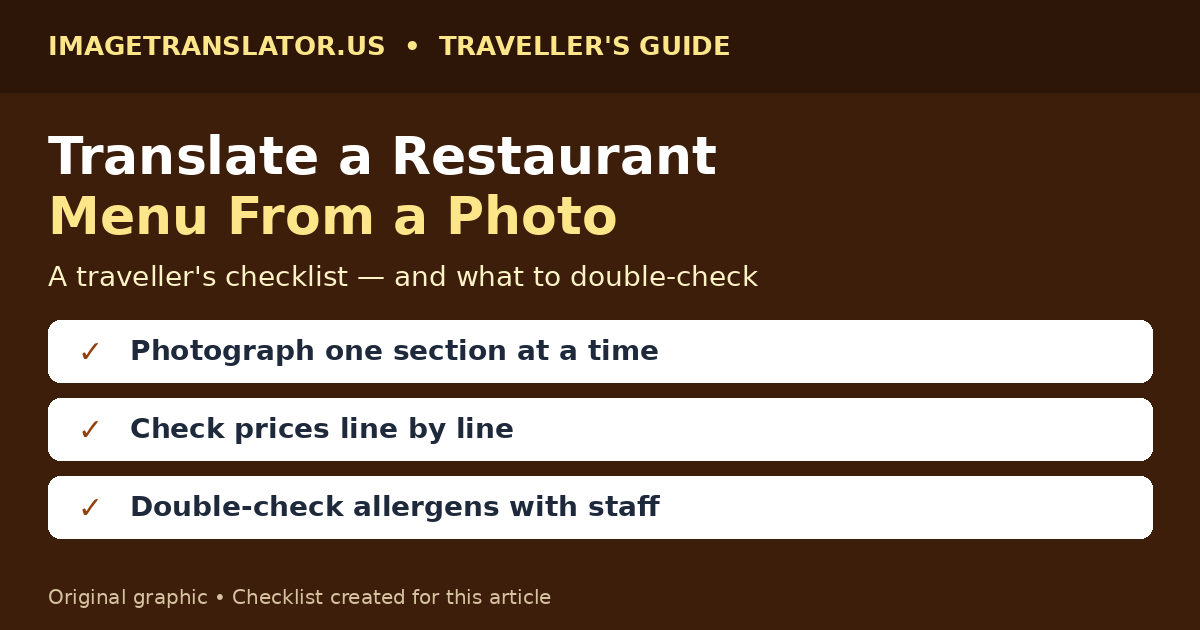
How to Translate a Restaurant Menu From a Photo: A Traveller’s Checklist (and What to Double-Check)
You sit down in a restaurant in Lisbon, Bangkok or Istanbul, the waiter hands you a menu with no English version, and your phone is the only translator at the table. A photo of the menu should solve the problem in seconds — and it usually does, for the easy half. The hard half is the part that decides what you actually eat: a dish name that translates literally but means something different, an allergen hiding in a word you did not recognise, or a price attached to the wrong line. This guide is the traveller’s checklist for translating a restaurant menu from a photo, including the double-checks that keep a good translation from turning into a wrong order.
Start here: our free menu photo translator reads the text in your menu photo and translates it to English in seconds, in your browser. Upload a photo of the menu, pick the language, and work through the checklist below with the translation in hand.
Before You Order: The 8-Step Menu Photo Checklist
1. Photograph the menu before you are hungry and hurried
Take the photos as soon as the menu arrives, while you still have time to retake a bad shot. Menus photographed in a rush — at an angle, in dim light, with a thumb over the corner — are the ones that mistranslate. You need the photo to be good before the waiter comes back, not after.
2. Shoot one section at a time, not the whole menu
A full menu in one photo means small text, and small text is the biggest cause of translation errors. Photograph starters, mains, drinks and desserts as separate shots. Each section should fill the frame, with the dish names large and readable. Translating section by section also keeps prices on the right lines — a whole-menu translation is where prices most often wander to the wrong dish.
3. Hold the phone straight and steady
Menus lie flat or lean in a stand, and a photo taken at an angle distorts the letters. Hold the phone directly above the page, keep the lines of text level in the frame, and brace your elbows on the table if your hands are not steady. Two seconds of care here saves a retranslated page later.
4. Get the light right — no flash, no shadow
Restaurant lighting is often warm and dim, and a camera flash creates a bright patch that wipes out the words underneath it. Move the menu towards the light, or tilt it slightly so the glare slides off the text. If your own shadow falls across the page, shift the menu or your seat. Our guide to 9 OCR mistakes and how to fix each one covers the same problems in detail — glare and blur are the top two.
5. Translate the section, then read the whole section — not just one dish
A single dish name translated alone can mislead you. Read the full section translation and ask whether it hangs together: are the starters actually starters, do the prices rise sensibly from small plates to mains, does anything read like it belongs in a different section? A mistranslated dish is much easier to spot in context than on its own.
6. Translate dish names twice: once in the list, once alone
Dish names are the most error-prone words on a menu, because they are often idioms, place names or a chef’s invention rather than plain description. If a dish matters to you — it is the speciality, or the only vegetarian option — crop the photo to that one line and translate it alone. A single-line translation is read more accurately than a line buried in a list, and comparing the two versions tells you whether to trust the first one.
7. Check the prices line by line against the photo
Prices are the numbers most likely to land next to the wrong dish, especially on menus where the price sits in a separate column. Read each price in the photo itself and match it to the translated dish name. If the menu uses a currency you do not know, confirm the symbol before you order — and remember that a “set menu” price usually covers several courses, while a single number next to a dish is that dish alone. Our guide to translating labels and price lists from photos covers the same line-matching habit for shopping.
8. Keep the original photo open while you order
When the waiter asks what you would like, point at the dish on the original menu as well as saying the translated name. The photo is your backup: if the translation was wrong, the waiter sees the dish you actually pointed at. This costs nothing and has saved more travellers from wrong orders than any translation trick.
What to Double-Check: Allergens First
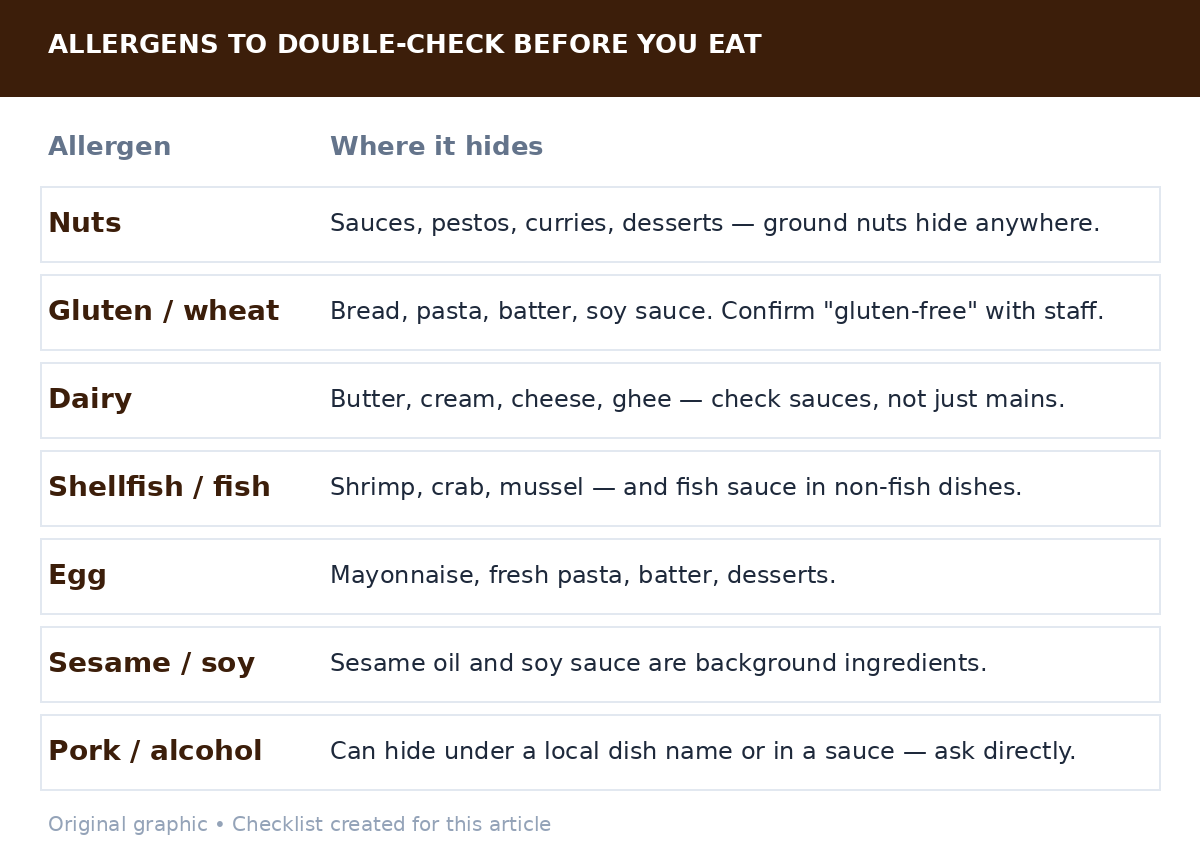
A wrong dish is an inconvenience. A missed allergen is a medical problem. Menu translations fail on allergens more often than on anything else, because allergen words are short, similar to other words, and sometimes abbreviated. Double-check these before you eat, not after:
- Nuts: peanut, tree nut, almond, walnut, cashew, pistachio, hazelnut. Sauces, pestos, curries and desserts hide them; a dish that does not look nutty can still contain ground nuts.
- Gluten and wheat: bread, pasta, batter, breadcrumbs, soy sauce (which usually contains wheat). “Gluten-free” on a translated menu deserves a direct question to staff — translations sometimes drop the “free”.
- Dairy: milk, butter, cream, cheese. Clarified butter (ghee) and cream sauces are easy to miss in translation.
- Shellfish and fish: shrimp, prawn, crab, mussel, fish sauce. Fish sauce in particular appears in dishes that are not obviously fish dishes, and it translates poorly in some languages.
- Egg: mayonnaise, fresh pasta, batter, some desserts. Egg is often an ingredient rather than a headline item, so it hides in the small print of a dish description.
- Sesame and soy: sesame oil and soy sauce are background ingredients in many cuisines and are easy for a translation to skip or garble.
- Pork and alcohol: relevant for religious or personal dietary rules. Pork can hide under a local dish name, and alcohol can hide in a sauce or dessert description. If either matters to you, verify with the waiter directly.
The rule that matters most: if you have a severe allergy, a photo translation is never enough on its own. Use it to shortlist safe-looking dishes, then show the waiter the original menu line and ask — or show a written allergy card in the local language — before you eat. A translation tells you what the menu says; only the kitchen can tell you what is actually in the dish. For the same reason, never rely on a photo translation for a medicine label or a safety warning — see our guide to translating medication labels safely when abroad.
What to Double-Check: Dish Names and False Friends
Dish names are where menu translation is most creative and least reliable. Four traps recur:
Literal translations that mislead. A dish name translated word for word can describe the ingredients while missing the dish. “Old clothes” is a literal translation of a real dish name (ropa vieja, shredded beef) — nobody orders it for the clothing. If a translated dish name sounds like an object rather than food, translate it again on its own, or search the original name: it is probably a traditional dish with a real recipe behind the literal words.
False friends between languages. Some food words look identical across languages and mean different things — and menus are full of them. A word you recognise from your own language may be a different ingredient abroad. When a dish name contains a word you think you know, check it against the rest of the description rather than trusting recognition alone.
Place names and people’s names. Dishes are often named after towns, regions or chefs, and a translator may try to translate the name itself. If a dish name contains a word that looks like a place, leave it untranslated in your head and ask what the dish is — the name is a label, not a description.
Cooking methods matter as much as ingredients. Raw, cured, smoked, fermented, deep-fried and steamed are not interchangeable, and a translation that drops the cooking method can turn a safe choice into a surprise. Pay attention to the verbs in a dish description, not just the nouns — and if the description is very short, ask the waiter how the dish is prepared.
Menu Words Worth Knowing Before You Travel
You do not need to learn a language to order dinner, but a dozen menu words in the local language will catch the errors a translation misses. These are common examples from widely travelled cuisines — check the ones that apply to your destination before you go:
| Word you may see | Language | It means | Why it matters |
|---|---|---|---|
| pollo / poulet / Hähnchen | Spanish / French / German | Chicken | The most common main-course protein |
| cerdo / porc / Schweinefleisch | Spanish / French / German | Pork | Dietary and religious rules |
| mariscos / fruits de mer | Spanish / French | Shellfish / seafood | Allergy — check before ordering |
| picante / épicé / scharf | Spanish / French / German | Spicy / hot | Heat level, not just flavour |
| sin gluten / sans gluten | Spanish / French | Gluten-free | Confirm with staff — “free” is easy to lose in translation |
| vegano / végétalien | Spanish / French | Vegan | Vegetarian and vegan are different dishes |
| al horno / au four / gebacken | Spanish / French / German | Baked / oven-cooked | Cooking method changes the dish |
For menus in Thai, Arabic or Chinese, the same idea applies with a different script — our guides to translating Thai text in images and Chinese in photos explain how to handle the script traps in those languages, and our French and German guides cover the two most common European menu languages in more depth.
When the Menu Photo Translation Looks Wrong
Some menus defeat even a good photo. Handwritten daily specials, chalkboards, menus printed in decorative script, and laminated pages with reflections are the usual suspects. The fixes are practical: ask for the printed menu if one exists, photograph the chalkboard in sections, and for handwritten specials, translate one line at a time — handwriting is read far more accurately in isolation than in a block.
If a dish translation still makes no sense after a retake, treat the original name as a search term: type it into a search engine and see what dish comes up. A traditional dish will have recipes and photos attached to its real name, and that tells you more than any literal translation. And if you are choosing between two dishes and one translation looks unreliable, order the one you are sure about — a menu is not the place to gamble on a guess.
Frequently Asked Questions
Can I trust a photo translator for a restaurant menu?
For choosing between dishes, yes — with the checklist above. Photo translation is accurate for most printed menus when the photo is clear and each section is translated separately. For severe allergies or strict dietary rules, use it to shortlist dishes and confirm with the waiter before eating; the kitchen’s answer is the one that counts.
Why do prices end up next to the wrong dish?
Because menus often put prices in a separate column, and the translator can attach a price to the line above or below it. Photograph and translate one section at a time, and check each price against the photo itself rather than trusting its position in the translation.
What is the best way to photograph a menu in a dark restaurant?
Move the menu towards the nearest light rather than using flash, hold the phone straight above the page, and photograph one section at a time so the text is large. If the page is laminated and reflecting the light, tilt it slightly until the reflection slides off the words.
How do I check a dish name that translates strangely?
Translate the single line on its own as a tighter crop, then search the original dish name — traditional dishes usually have recipes and photos under their real name. If the name still looks like an object rather than food, it is probably an idiom or a place name, and the waiter can explain it in seconds.
Does the translator work on handwritten menus?
Printed menus translate best. Handwritten menus and chalkboards work if the writing is neat and you translate one line at a time, but decorative handwriting and daily specials written in a hurry are the least reliable — ask staff about those dishes directly.
A menu photo translation is at its best when you treat it as a smart first pass, not a final answer: good photos, section by section, prices checked against the original, allergens double-checked, and the waiter confirming anything that matters. Do that and you will order what you meant to order — in any language. Try it on your next meal with our free travel image translator, and keep the checklist on your phone: it takes a minute, and it is the difference between a great dinner and a dish you did not want.
