
A photo translator can tell you what a foreign medicine label says, what a warning sign means, and what a form is asking for. That is genuinely useful — and it is also exactly where a wrong translation does the most harm. A mistranslated menu costs you a disappointing dinner. A mistranslated dosage, warning or legal form can cost you much more.
This guide explains how to translate a document photo safely: what to photograph, how to check the result, and — most importantly — when to stop and get a certified translation from a qualified human translator instead.
To translate your own document photo right now, use the free image translator — upload the photo, pick the languages, and check the result with the steps below before you act on it.
The One Rule for Safety-Critical Translation
Machine translation is a tool for understanding, not for deciding. It is excellent at telling you roughly what a document says. It is not reliable enough to be the only basis for a medical, safety or legal decision.
So the rule is simple: use a photo translator to understand what you are looking at, then verify anything you are going to act on — a dose, a warning, a signature, a deadline — with a second source. That second source might be a pharmacist, the document’s issuer, a bilingual person you trust, or a certified translator. Which one depends on what is at stake, and this guide works through each case.
If you remember one thing from this article, make it this: a translation that looks confident is not the same as a translation that is correct. Machine translation does not hesitate, even when it is guessing.
Medicine Labels: Dosage, Warnings and Expiry
Medicine labels are the most common safety-critical photo translation, and the most dangerous to get wrong. A label has a small number of facts that matter enormously: what the medicine is, how much to take, how often, who must not take it, and when it expires.
Photograph the whole label, then the details. Take one photo of the full box or bottle so you can see the layout, then close-up photos of the dosage section, the warnings section and the expiry date. Small print is where dosage errors hide, and a close-up gives the translator a clean image to work with.
Check four things, in this order:
- The active ingredient and strength. This is the drug’s name and dose — for example, 500 mg per tablet. If the translation gives you a drug name you do not recognise, do not guess. Look the original word up, or ask a pharmacist.
- The dosage and frequency. “Take one tablet twice daily” and “take two tablets once daily” are easy to confuse when a translation drops a number. Read the numbers in the original photo yourself — digits usually survive translation unchanged — and check them against the translated words.
- The warnings. Allergy warnings, “do not take with alcohol”, “may cause drowsiness”, “not for children under 12” — these are the lines that matter most, and they are also the lines most likely to be phrased indirectly in the original language. If a warning is unclear, treat the medicine as unsafe until a pharmacist confirms it.
- The expiry date. Date formats differ by country: 03/04/2027 can mean 3 April or 4 March depending on where the medicine was made. Check the date format of the country of origin, not your own.
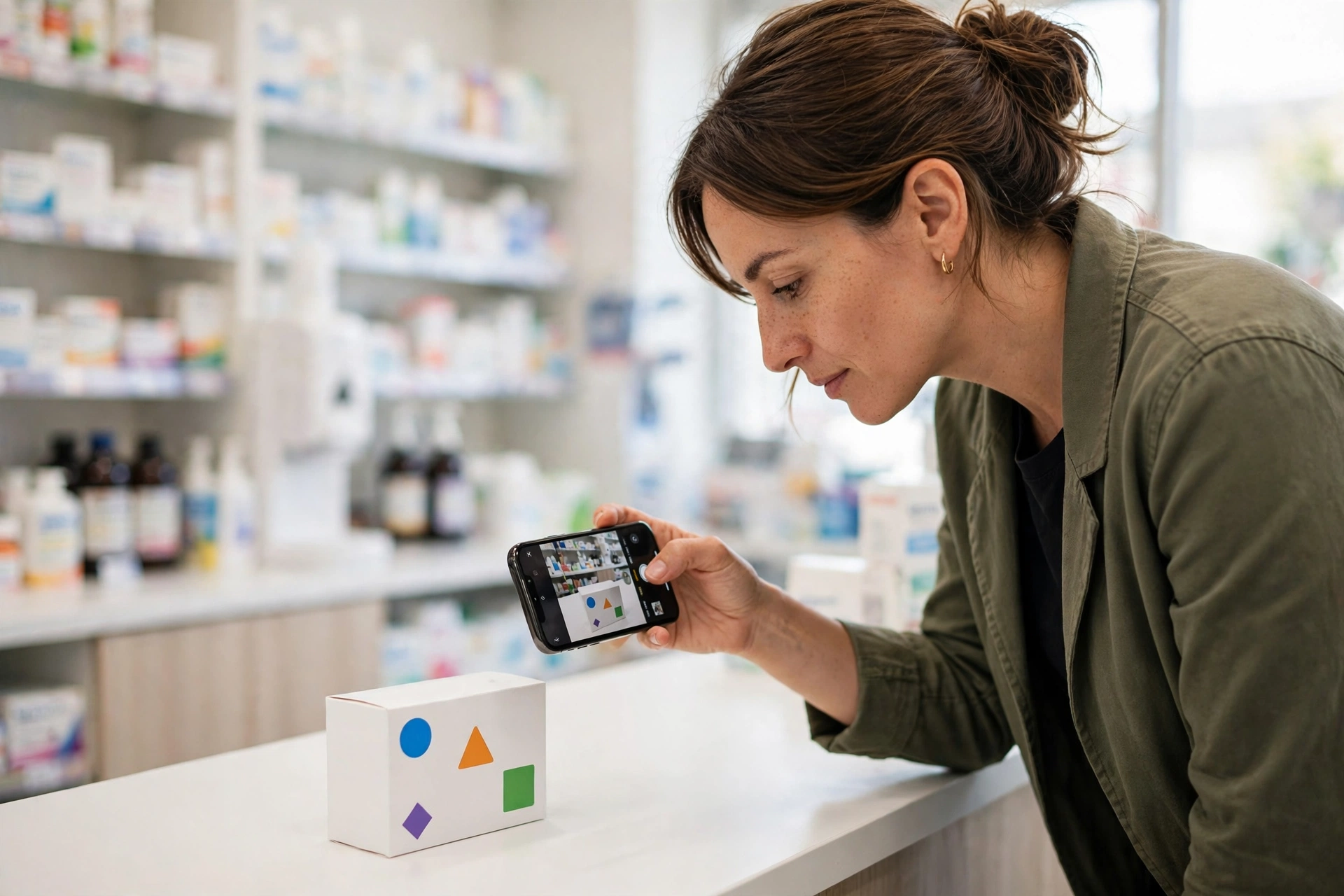
A worked example. Imagine a small box photographed in a pharmacy abroad. The label — an invented example written for this guide — reads as a typical pain-relief label: an active ingredient, a 500 mg strength, “one tablet every 6 hours, maximum 4 tablets in 24 hours”, a warning not to combine it with alcohol, and an expiry date. Translated carefully, that gives you a clear picture. But notice what the translation cannot tell you: whether this medicine interacts with something you already take. That question needs a pharmacist, not a photo translator. When in doubt, show the pharmacist the original box — the photo and the translation together.
Our dedicated guide to translating medication labels safely when abroad goes deeper on dosage checks and what to ask a pharmacist.
Warning Signs: Read the Symbol First, Then the Words
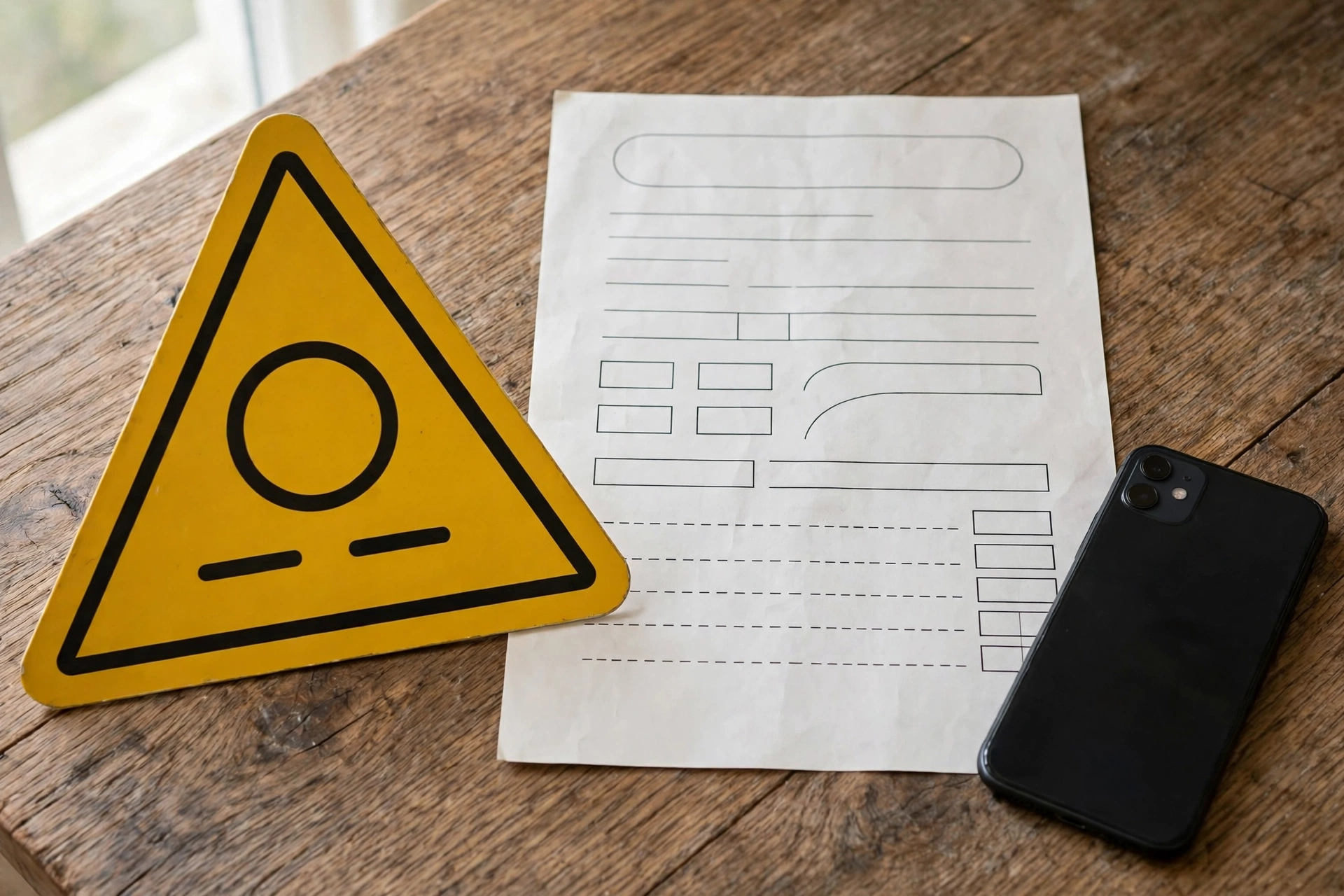
Warning signs are designed to be understood fast, and most of them lead with a symbol: a triangle, a pictogram of a hazard, a red circle with a line through it. Read the symbol before you translate the words. The symbol tells you the category — danger, prohibition, mandatory action — and the words add the detail.
Common warning-sign words worth recognising in translation:
- Danger / warning / caution — the severity level. “Danger” means serious injury is possible; “caution” means a lesser hazard.
- Prohibited / forbidden / do not — something you must not do. Check what follows carefully, because a mistranslated prohibition can invert the meaning: “do not enter” becoming “do enter” is a real risk with short sign text.
- High voltage / flammable / toxic / slippery surface — the specific hazard. These words are usually standardised, which makes them easier to translate accurately — but verify them against the symbol.
- Keep out / restricted area / authorised personnel only — access rules. If you are unsure whether a sign bans entry, assume it does until someone confirms otherwise.
Three habits make sign translation safer:
- Photograph the whole sign, not just the words. The symbol, the colour and the placement are part of the message. A red-bordered triangle means something different from a blue circle, even with similar words.
- Translate the full sign as one image. Short fragments lose context — a single word like “gas” could be a warning, an instruction or a label. The full sign gives the translator the sentence to work with.
- When a warning is ambiguous, obey the stricter reading. If a translation could mean either “do not drink this water” or “drinking water”, do not drink it. Caution costs nothing; the alternative can cost a great deal.
For street and travel signs generally, see our guide to translating street signs and airport boards while travelling.
Official Forms: What to Translate, and What Needs a Certified Translator
Official forms — visa applications, immigration papers, contracts, certificates, court documents, employment forms — are a different category from labels and signs. With a label, you need to understand the content. With an official form, the translation itself may need to be accepted by an authority, and that changes everything.
Use a photo translator to understand the form. Photograph each page, translate it, and work out what the form is asking: your name, address, dates, declarations, signatures. This is the right use of the tool — it tells you what you are dealing with before you fill anything in. Our guide to translating a scanned document to English covers the photography and scanning steps that give the cleanest results.
Do not use a machine translation as the submitted translation. If a government agency, university, employer, court or immigration office asks for a translated document, it almost always requires a certified translation — a translation done by a qualified translator who signs a statement that it is complete and accurate, often with a stamp or credentials attached. A photo-translator printout is not a certified translation, and submitting one can delay or invalidate your application.
When to stop and get a certified translation:
- The document will be submitted to a government agency, court, university or employer.
- It is a birth, marriage or death certificate, a diploma, a police record, or a medical record.
- It is a contract you are being asked to sign.
- It is an immigration or visa document of any kind.
- The form includes a declaration, an oath or a statement you must swear is true.
In all of these cases, the cost of a certified translation is part of the process — budget for it, and use the photo translation only to understand the document while you arrange the real thing.
What a certified translator needs from you: the original document (or a clear scan), the target language, the country or authority the translation is for, and any deadline. Requirements vary by country — some authorities need a sworn translator, others accept a certified translator’s signed statement — so check the receiving authority’s rules first and tell the translator what they are.
How to Photograph a Document for the Best Translation
A good photo is half the translation. Before you photograph any label, sign or form:
- Use flat, even light. Shadows across the text are the most common cause of misread words. Photograph near a window in daylight, or under a bright lamp, with the light behind you.
- Photograph straight on. An angled photo stretches the letters. Hold the phone parallel to the document.
- Fill the frame with the text. The bigger the letters, the better the recognition. For a long form, photograph one section at a time rather than the whole page from a distance.
- Keep the whole word in frame. A cut-off word is a guessed word. Check the edges of the photo before you translate it.
- For small print, take a close-up. Dosage instructions and form footnotes are printed small. A close-up of the relevant section translates far better than a wide shot of the whole page.
If a translation comes back wrong, the photo is usually the cause, not the language. Our troubleshooting guide to why image translations go wrong lists the nine most common photo problems — blur, glare, fonts, handwriting — and how to fix each one.
A Checklist Before You Act on Any Safety-Critical Translation
Run through this list before you take a medicine, obey a warning, or sign or submit a form based on a photo translation:
- Is the photo clear, straight and complete — no cut-off words?
- Did you translate the full section, not just one word?
- Do the numbers — dosage, dates, quantities — match the digits in the original photo?
- Does the translation make sense in context, given the symbol, the layout and the situation?
- Have you checked the warnings, not just the instructions?
- For a form: is this translation only for your understanding, or does it need to be certified?
- For medicine: has a pharmacist seen the original label?
- If anything is unclear, have you chosen the safer interpretation?
If you cannot answer yes to the checks that apply, do not act yet. Get a human to verify — a pharmacist for medicine, the sign’s owner or local staff for a warning, a certified translator for a form.
Frequently Asked Questions
Can I use a photo translator for a medicine label? Yes, to understand what the label says — the drug, the dose, the warnings and the expiry date. But verify the dosage and warnings with a pharmacist before taking the medicine, and never rely on a single photo translation for a health decision.
Is a photo translation the same as a certified translation? No. A certified translation is done by a qualified translator who signs a statement that it is complete and accurate. A photo translator’s output is a machine translation with no such guarantee, and authorities will not accept it as a certified translation.
When do I need a certified translation? When a document will be submitted to a government agency, court, university, employer or immigration office — including certificates, diplomas, contracts and visa documents. Use a photo translator to understand the document, then hire a certified translator for the version you submit.
How do I translate a warning sign from a photo? Photograph the whole sign including its symbol, translate the full sign as one image, and read the symbol first — it tells you the hazard category. If the translation is ambiguous, follow the stricter reading.
What should I do if a form is in a language I cannot read? Translate it with a photo translator to understand what it asks, then check whether the receiving authority needs a certified translation. For visa, immigration, court or contract documents, arrange a certified translation rather than submitting a machine translation.
Can I trust a photo translator for an official form? For understanding the form, yes — with the photo and checking steps in this guide. For submitting the form or signing a declaration based on it, no: get a certified translation and, where the form is a contract or legal declaration, advice from a qualified professional.
Final Thoughts
Photo translation is a powerful way to understand a foreign medicine label, warning sign or official form — and understanding is the right goal. The moment understanding turns into action, the stakes change: check the numbers, read the warnings, and know where machine translation ends. For a dose, ask a pharmacist. For a document that must be accepted, get a certified translation. The photo translator gets you oriented; the human expert gets you safe.
