
This article is part of our complete guide to image translation for business and documents. To translate your own picture right now, use our free image translator.
Selling products internationally can open the door to customers in many different countries. However, expanding an e-commerce business globally involves more than simply listing a product on another country’s marketplace.
Your product packaging also needs to communicate clearly with international customers.
Packaging may contain product names, descriptions, instructions, ingredients, warnings, measurements, marketing messages, and other important information. If this content is written in only one language, customers in other markets may have difficulty understanding the product.
For e-commerce sellers, translating packaging can therefore be an important part of preparing a product for global markets.
Fortunately, image translation technology can help sellers quickly understand and translate text directly from packaging designs, product photos, labels, and artwork.
In this guide, we will explain how to translate packaging design for global markets, how image translation can help e-commerce sellers, and what to consider when preparing packaging for customers in different countries.
Why Packaging Translation Matters for Global E-commerce
When customers purchase a product, packaging is often one of the first things they see.
A package can communicate:
- What the product is
- How it should be used
- What it contains
- Who it is intended for
- Important warnings
- Product benefits
- Instructions
- Storage information
- Company information
If customers cannot understand the language on the package, they may hesitate to purchase the product.
For international e-commerce sellers, translating packaging can make products more accessible to customers and help create a more localized shopping experience.
What Parts of Packaging Should Be Translated?
Packaging can contain many different types of text.
Depending on the product, you may need to translate:
- Product names
- Product descriptions
- Instructions
- Ingredients
- Warnings
- Safety information
- Storage instructions
- Usage directions
- Marketing slogans
- Product features
- Manufacturing information
- Customer support information
- Website addresses
- Warranty information
Not every piece of text necessarily needs to be translated in the same way. Some brand names and trademarks may remain unchanged across markets.
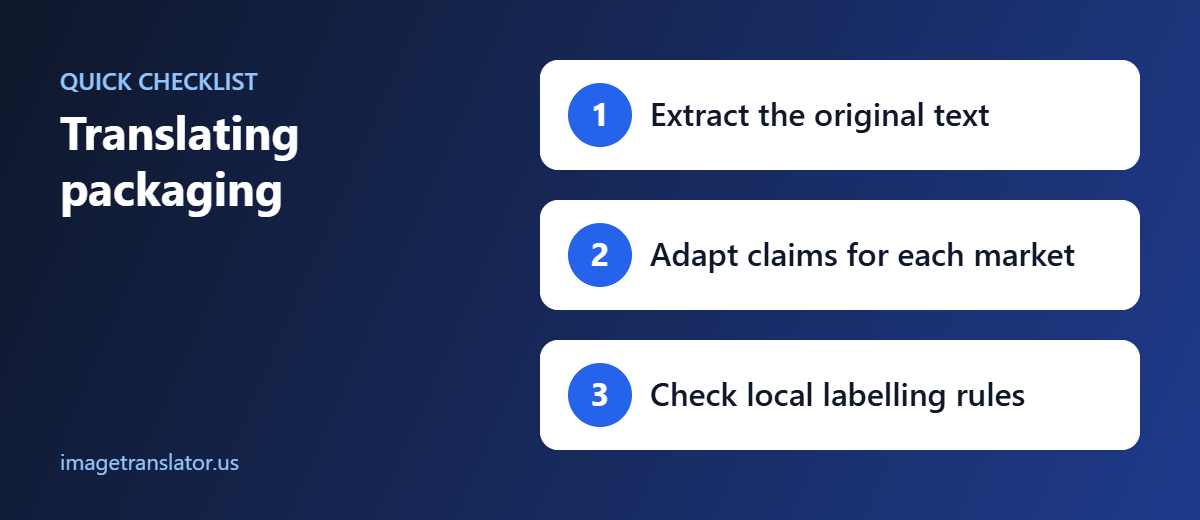
Step 1: Create a High-Quality Image of Your Packaging
Before translating a packaging design, obtain a clear image of the package.
You might have:
- A product photograph
- A packaging mockup
- A PDF converted to an image
- A label design
- A box design
- A bottle label
- A pouch design
- A product insert
- A screenshot from your design software
High image quality is important because image translation tools rely on text recognition technology.
Small, blurry, or distorted text can be harder for OCR systems to recognize.
Step 2: Upload the Packaging Image
Once you have your packaging image, upload it to an image translation tool.
ImageTranslator.us allows you to upload images containing foreign-language text and translate the text into another language.
Translate Packaging with ImageTranslator.us
This can be particularly useful when an e-commerce seller receives packaging artwork from an overseas supplier and wants to understand the text before adapting it for another market.
Step 3: Select the Source and Target Languages
Choose the original language used on your packaging and the language you want to translate it into.
For example:
Source: Chinese
Target: English
Or:
Source: English
Target: German
You may need multiple translations if you plan to sell the same product in several countries.
For example, an international product might require English, Spanish, French, German, Italian, and other language versions.
Step 4: Identify All Text That Needs Translation
Before creating the final packaging design, review the entire image.
Do not focus only on the main product name.
Look for smaller text such as:
- Ingredient lists
- Instructions
- Warnings
- Labels
- Product specifications
- Measurements
- Storage information
- Contact details
Small text is easy to overlook, especially when it appears on the side or back of a package.
Translating Packaging for Amazon Sellers
Amazon sellers often target customers in multiple countries.
A product may be sold through different Amazon marketplaces, where customers speak different languages.
For example, a seller may operate in:
- United States
- United Kingdom
- Germany
- France
- Italy
- Spain
- Canada
- Japan
Before using the same packaging design across different markets, review the language requirements and applicable regulations for each destination.
Image translation can help you understand existing packaging, but official product-label requirements should be verified for the specific market and product category.
Translating Packaging for Shopify Stores
Shopify sellers also frequently sell products internationally.
If you operate a Shopify store and ship products to customers around the world, localized packaging can improve the customer experience.
For example, an English-language product may be sold to customers in France or Germany.
Translating the package instructions and product information can make the product easier for those customers to understand after delivery.
This can be especially useful for products that require assembly, preparation, or specific usage instructions.
Step 5: Consider the Packaging Layout
Translation is not only about changing words.
Different languages can take up different amounts of space.
For example, a short English sentence may become longer when translated into another language.
This can affect:
- Text boxes
- Font sizes
- Product labels
- Headings
- Instruction sections
- Package dimensions
Before finalizing your design, check whether the translated text fits properly.
Avoid making the font extremely small just to fit a longer translation into the original space.
Translating Product Images for E-commerce Listings
Packaging translation is also useful for product images displayed on e-commerce websites.
Suppose your product photography shows packaging with text in Chinese.
If you want to sell the product to English-speaking customers, you may want to create localized product images that show the information in English.
An image translator can help you understand the original text before creating localized marketing assets.
However, sellers should make sure their final product images accurately represent the actual product and comply with the marketplace’s image and listing requirements.
Translating Ingredients and Product Information
For food, cosmetics, supplements, and similar products, packaging may contain detailed ingredient information.
This information can be particularly important to customers.
An image translator can help sellers understand an existing ingredient list before preparing localized packaging.
However, automated translation should not be treated as the final authority for regulatory labeling.
Ingredient names, allergens, warnings, units, and legally required statements should be reviewed by an appropriately qualified translator or regulatory professional when necessary.
Translate Product Instructions
Instructions are another important part of packaging localization.
A product might include instructions such as:
- Open the package.
- Add the required amount.
- Assemble the components.
- Store in a cool location.
- Keep away from children.
If these instructions are not understandable to customers, they may use the product incorrectly.
Clear, professionally reviewed translations can make instructions easier for international customers to follow.
Be Careful with Marketing Slogans
Marketing slogans can be more difficult to translate than simple product information.
A literal translation may not have the same meaning or emotional impact in another language.
For example, a slogan that sounds natural in English may sound awkward when translated word-for-word into Japanese, German, French, or Spanish.
For important branding campaigns, consider working with a professional localization specialist rather than relying entirely on automated translation.
The goal should not always be a literal translation. It may be more appropriate to adapt the message to the target market while preserving the original brand concept.
Use Image Translation During Product Research
Image translation can also be useful before you even create your own packaging.
E-commerce sellers often source products from international suppliers.
A supplier may send:
- Product catalogs
- Packaging photographs
- Labels
- Instruction manuals
- Product specifications
- Factory samples
If these materials are written in a foreign language, you can upload the images to an image translation tool to understand the content.
This can help you communicate more effectively with suppliers and identify important product information.
Translate Packaging Before Ordering Large Quantities
One useful workflow for e-commerce sellers is to translate and review packaging before placing a large manufacturing order.
You can:
- Receive the packaging artwork.
- Upload the design to an image translator.
- Identify all foreign-language text.
- Translate the information.
- Review the meaning.
- Send the final text to your designer.
- Create the localized packaging.
- Have the final version professionally reviewed when required.
- Order the packaging.
This can help identify translation issues before thousands of packages are printed.
Keep Brand Names Consistent
Your brand name should generally remain consistent across markets unless you have intentionally developed localized branding.
Make sure the following information is consistent:
- Brand name
- Product name
- Model number
- Website
- Contact information
- Trademark information
A translated packaging design should still clearly represent the same product and brand.
Check Measurements and Units
International markets may use different measurement systems.
For example, product packaging may display:
- Ounces
- Pounds
- Inches
- Fahrenheit
- Fluid ounces
Other markets may commonly use:
- Grams
- Kilograms
- Centimeters
- Celsius
- Milliliters
When localizing packaging, check whether measurements need to be converted or displayed in an additional format.
Do not change numerical information casually. Verify conversions and any market-specific labeling requirements before printing.
Common Packaging Translation Mistakes
Translating Only the Front
The front of the package may be translated while important information on the back remains in the original language.
Review the entire package.
Ignoring Small Text
Warnings and instructions may be printed in small fonts but can still be important.
Using Literal Marketing Translations
A word-for-word translation may not communicate the intended message.
Overlooking Layout Changes
Translated text may require more space than the original.
Not Reviewing Numbers
OCR can sometimes misread numbers, especially in low-quality images.
Always verify prices, measurements, dates, product codes, and other numerical information.
How ImageTranslator.us Can Help E-commerce Sellers
ImageTranslator.us can be a useful part of the packaging localization workflow.
Instead of manually typing text from a product image, sellers can upload the image and translate the visible text.
It can be useful for reviewing:
- Product packaging
- Labels
- Supplier images
- Product manuals
- Product inserts
- Marketing graphics
- International product photos
This can save time during product research and the early stages of packaging localization.
AI Translation Is a Starting Point, Not Always the Final Step
AI and image translation can make the translation process faster, but the appropriate level of human review depends on the type of product and the market.
For simple marketing text, automated translation may provide a useful starting point.
For legally required labels, safety warnings, regulated products, ingredients, medical information, or other critical content, professional review may be necessary.
Always check the labeling and consumer-information requirements that apply to your specific product and target market.
Final Thoughts
Expanding an e-commerce business internationally requires more than translating a product listing. Your packaging also needs to communicate clearly with customers in the target market.
Image translation can help sellers understand existing packaging, supplier artwork, product labels, instructions, and other visual content.
With ImageTranslator.us, you can upload a packaging image, identify foreign-language text, and translate it into a language you understand.
Translate Your Packaging Image
Use image translation as part of your localization workflow, then review important content carefully before producing final packaging. For regulated information, safety instructions, ingredients, and legally required labeling, use appropriate professional or regulatory review.
With the right combination of AI tools, professional translation, and careful design, e-commerce sellers can make their packaging easier to understand and prepare their products for customers around the world.
Further Reading
- Internationalization and localization: the difference between translating and adapting content for a market.
- Packaging and labeling: what information product packaging usually has to include.
